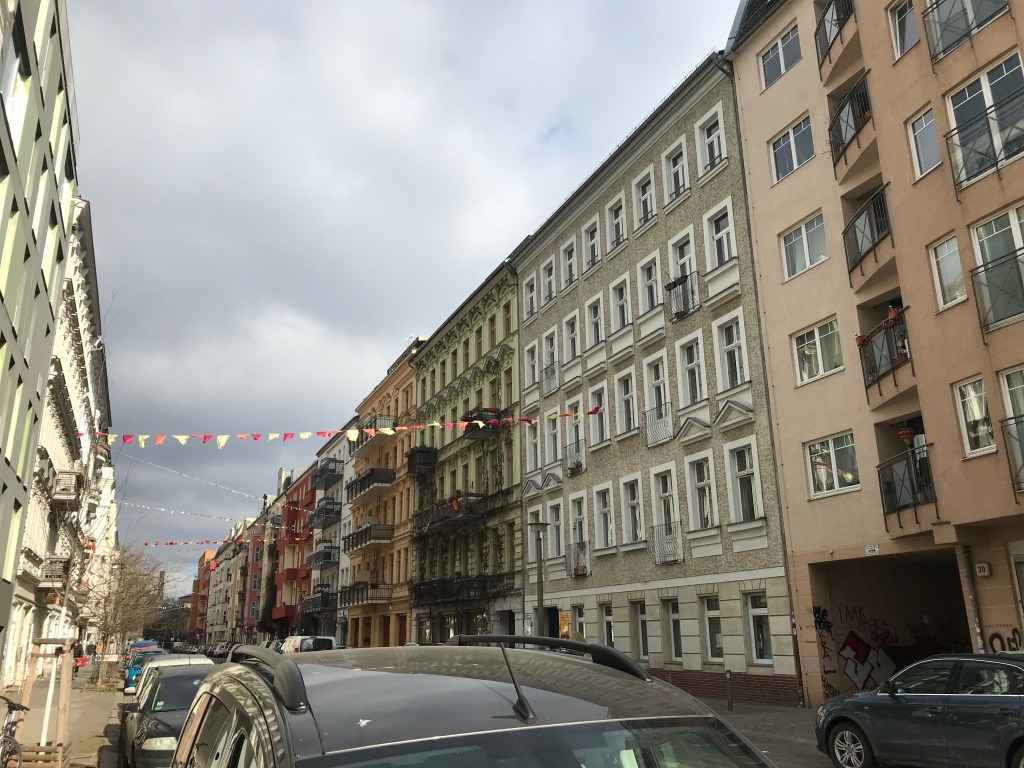
On the 27th of February, over a feast of burgers, two variations of fries, and onion rings, my friend and I clinked pints of Berliners Pilsner to what we presumed to be our final night in Germany.
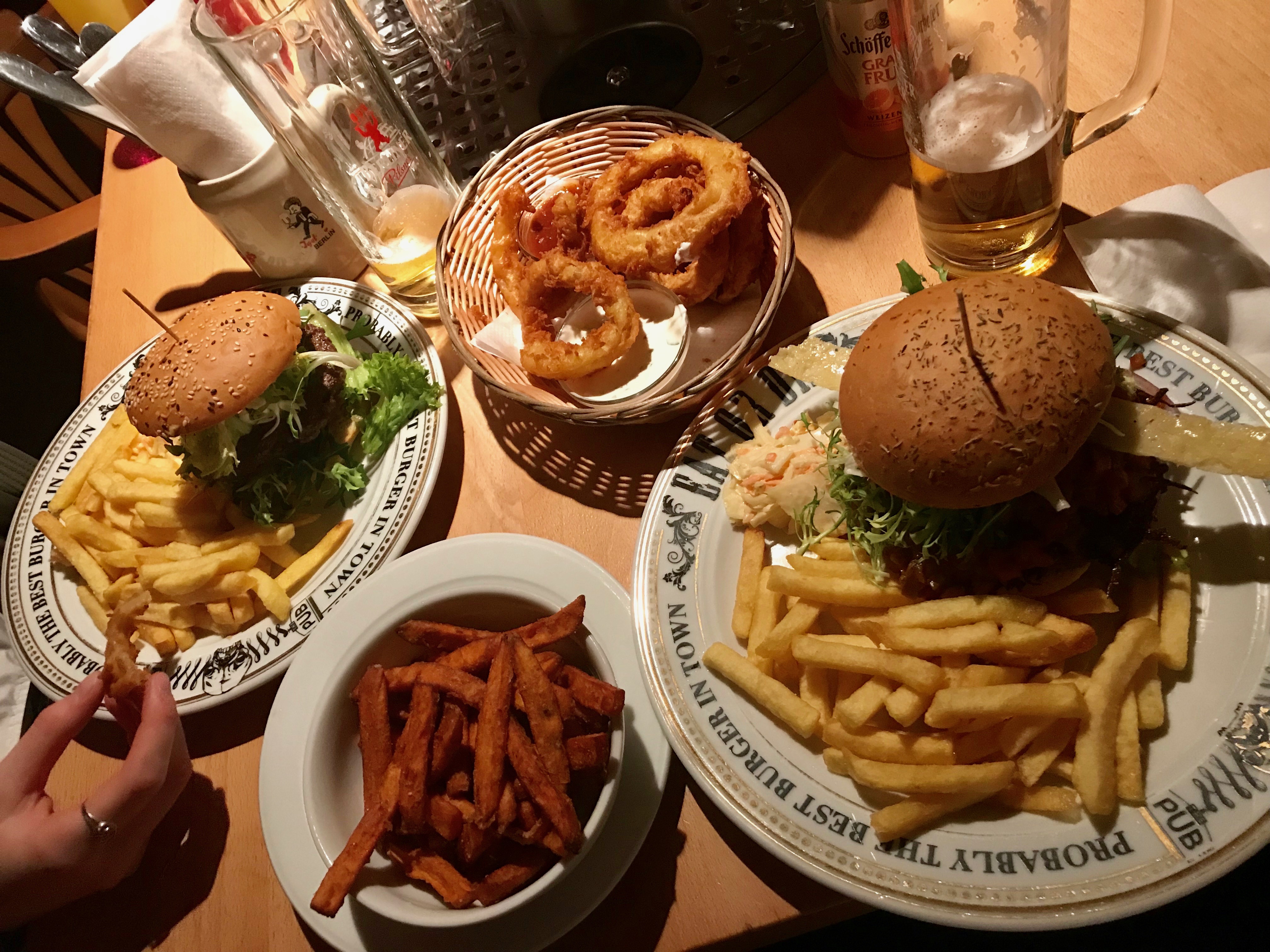
It had been a reposeful four days, a brief but fulfilling holiday of exploration and food adventures. Apart from the bitter cold and our dwindling funds, we had nothing disagreeable to say about our little getaway. We had eaten (more than) well, seen the striking landmarks of Berlin, and walked across nearly the entire city. A satisfactory few days spent away from our school work, away from the tedium of mid-term apprehension and social exhaustion, had us yearning again for Dublin. For home.
We could not have predicted it would take us three nights, two planes, four trains, several taxi rides, a boat, and 7 cancellations to get there.
So let me tell you about the time we devoted every ounce of our energy, every spare second of our time, every pinched penny we’d saved up, to getting home. Let me tell you about the time we crossed three countries in a day, waking up without knowing where we would lay our heads to rest at night. Let me tell you about how quickly it changed me.
We awoke early the morning following our “last night,” eager to be home, to finally utilise the remainder of our reading week for its true purpose: reading. In our attempt to fully immerse ourselves in the holiday experience, we’d left our school work behind, promising to return to it with vim and vigour come Wednesday, the day of our arrival home.
A discouraging four hour delay to our initial flight back to Dublin had us seething, but we felt certain we’d make it back by the evening. We had our night planned out: get in a quick grocery shop, catch up with friends, and be early to sleep in our own snug beds.
The first cancellation said otherwise.
Neither my travel companion nor I had dealt with the sudden and grim dilemma that is being stuck in a foreign country with nowhere to go. It is a strange feeling, the sense of paralysis, of imprisonment, in the withholding of something we have no ability to do ourselves. In spite of our vexation, of the vexation of so many around us, we were at the mercy of bad weather, regulatory decisions, and Aer Lingus.
Dublin had taken a light coating of snow, which is significantly more snow than it ever receives, and its premier airline had decided to call it quits on flights from around Europe. So we were stuck.
Almost giddy with indignation and alarm, I took to searching for a place to stay for the night. I was frustrated –I wanted to find a way back that same night– but our options seemed null.
We trudged back to the city from Berlin Tegel Airport with heavy hearts, caught between hilarity and dolefulness. Lacking the will to do anything else, we planted ourselves at the bar of our new hostel and pondered our options.
In the midst of this apparent crisis, my father gave me several fragments of wisdom that lifted my spirits and affirmed my underlying philosophy entirely. Chuckling as I relayed to him our experience, he reminded me of the famous John Lennon quote, “Life is what happens to you while you’re busy making other plans.” He told me a story of the time he was stranded in Scotland and rediscovered what it meant to play creatively and with childlike curiosity, how these outward mishaps can, in turn and ultimately, change our lives for the better. He told me to make a list of 100 things to accomplish in my lifetime instead of dwelling on that which I could not control.
And so, with few cheap bottles of Carlsberg down the hatch, we wrote our lists amid the eclectic din of our Berlin hostel.
That night we met a fellow from Brazil and a girl from Montreal. We played a pathetic game of pool and sang along to some killer songs over a plate of chips and a few pints, then fell prey to side-splitting laughter in the dim communal bathroom before bed.
We booked ourselves onto the next flight to Dublin set to leave the next morning at 11.
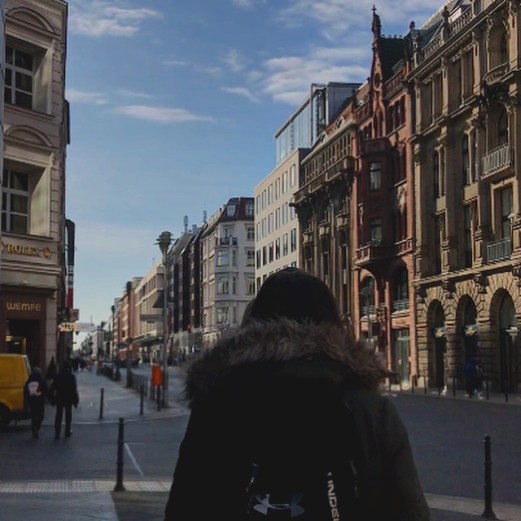
Confident that this would be the end of our time in Germany, we tried our best to seem unfazed by the forty-five minute delay to our flight right off the bat. I had a sinking feeling nonetheless. In an hour’s time, the whole thing was cancelled.
And so began the irreversible point of desperation.
Waiting in a dizzyingly long queue for cancellation service amid hundreds of other passengers whose flights to Ireland and the UK had been called off, we heard word that there wouldn’t be another flight to those regions until Sunday.
It was Thursday.
Perhaps if we were collectively more patient individuals, we might’ve just settled in to wait out the storm. It would have been easier. It would have saved us a great deal of confusion and numerous more cancellations to follow. But my travel companion and I were not in the state for patience. We wanted out.
The plan thus became convoluted and lengthy, but it would get us home before Sunday. We were to catch a short connecting flight from Berlin to Cologne, Germany, then from there, fly to Manchester, England, where we would then hop on a train to Holyhead (a pinprick of a port town on the western coast of Wales), then from there, catch a ferry home to Dublin. It could all be done and dusted before the following morning.
I gawked at the plan when my friend first presented it. I could hardly picture us getting out of Germany at this point, let alone reenacting scenes from the film “Planes, Trains, and Automobiles” (or in our case, ferries). But part of me –the travel-hungry, adventure-seeking part that callously tends to override the exhausted, responsible, rational-minded part– leapt at the idea of such an escapade. It thrilled me, despite the inconvenience, the potential for failure, the unpredictability of it all. I didn’t mind.
We booked our tickets and headed to Cologne.
The first indicator of our mistake was the cancellation of the ferry. We had just landed in our second German destination when news broke that our ferry would not, in fact, be leaving the port that night. But the ferry from Holyhead seemed worlds away when we were still a plane and a train away, so we decided we’d cross that bridge when we came to it. Rather cruelly, or perhaps kindly, we soon learned we wouldn’t have to.
Walking to the gate for our flight to Manchester, we found a cluster of concerned and weary-looking passengers bombarding airport staff with questions. We glanced at each other, our heartbeats quickening with each step closer to the gate. Not again. Not again.
Sure enough, in accordance with our archetype of good fortune, our flight had been cancelled. This was where I reached the precipice of losing my shit.
We sat on a bench for several minutes taking deep breaths and alternating who would be the strong one and who would be the snivelling baby. We’d made it to a new city, a new airport, but we were still stranded in Germany. I dropped my hands into my lap, shook my head, closed my eyes.
“I don’t know what we do now.”
Up to this point, we’d made decision after decision on our own, reworking plans to accommodate for our terrible luck, moving on quickly from disappointment to get to where we needed to be. We’d dedicated all our energy to do so. Already I’d begun to learn how futile it was to dwell in self-pity when it would only serve to slow us down, when we were the only ones watching out for ourselves, when no one else would stop to help make sure we would safely find our way home. I knew that now; I’d already begun to digest that newfound aspect of adulthood we’d unwillingly shouldered.
But for a moment, when we paused, when I remembered that, in many ways, I’m still a kid, I was afraid.
Maybe learning how to be an adult is best accomplished when thrown into the deep end, because after a few minutes we were up and moving again, ever-forward. A moment or two of panic is all you need, really, to recognise that life is going to proceed ahead with or without you, so you might as well gather up your fortitude and get moving with it.
We then waited in a two-hour line to have our flight rebooked. As night had begun to fall, we were given vouchers for a hotel and taxi rides to and from the airport, which momentarily made up for the bomb of disappointment that had been our day. And, upon arriving at the hotel, I truly understood the meaning of yin-yang, of there being a bead of good within the bad just as there is always a drop of bad amid good.
This hotel was nice.
After sleeping in hostels the past week, falling into the clean, personal, cloud-like hotel beds was enough to bring us to tears. And, as an added bonus, the hotel offered us a free buffet dinner as well as a free buffet breakfast the following morning before we left for our rescheduled flight.
We ate like queens.
I couldn’t fall asleep right away as I assumed I would, however. The past two days had been disorienting and transformative, unpredictable and tense, hilarious and heartbreaking. I knew where I was in a sort of detached way; I was a rose petal separated from the bud, drifting through the wind, yearning to land.
By some sort of miracle, our flight to Manchester had not been cancelled. We were careful now not to get our hopes up too high, and rightfully so; as we waited for our flight, we received notice that our rebooked ferry for later that evening had been cancelled. My resolve was steely now, unbreakable. We shrugged, made arrangements to rebook. Nothing could daunt us anymore.
After a delay, we finally boarded our flight and touched down in England. Hope began to swell in my chest like something living, something fresh and spirited, banging on gates to be set free.
We were finally a step closer to home.
An expensive cab ride to the Oxford Street station quickly doused the flame of our excitement. Our train to Holyhead, the next leg of our journey, had been cancelled.
High off the progress we’d made by arriving in Manchester that morning, we refused to take this for conclusive. Under the tinny babble of the announcements proclaiming nearly every train to have been cancelled due to adverse weather, we rushed from platform to platform seeking a way out. A kind gentleman working at the station informed us of a round-about route we could take, train-hopping, essentially, to eventually find ourselves at Holyhead.
With nothing to lose, we boarded the next train to Piccadilly Station, then onward to Crewe, England.
I’ve never seen much of the English countryside. On that day, I accidentally saw a good bit.
From Crewe, we hopped aboard a train to Chester, from which we finally boarded a direct, albeit slightly longer, train to Holyhead. Darkness befell us as we hurdled westward towards the coast, slightly disbelieving that we’d made it this far. We were entering our third country of the day.
I sat, staring blankly at my reflection in the blackness of the train window, taking in the dark circles beneath my eyes and the scarf I’d been wearing for three days straight. I thought, for the first time since the ordeal had begun, of how I truly felt.
I pondered the way familiarity feels like a hug, and how a smile from a stranger speaking broken English feels like an extension of good fortune amid a string of incessant road blocks. I thought about how sitting in an airport after a third flight cancellation can lead to a tug-of-war between laughter and tears, how not knowing and being afraid can morph into being excited by the unpredictability, feeling empowered by the chance to choose what the next course of action will be. I thought about how grateful I was to be joined by another strong woman, one who refuses to take life sitting down, and how things might be different for us when we would eventually make it home.
When we trundled into the station at Holyhead, snowflakes fell wet and heavy onto our eyelashes and cheeks. The ferry, set to leave at 2.30am, was still a-go. We shook our heads. We hugged in the middle of the mostly deserted port. We’d made it.
With time to spare, we wandered into town for a true last meal. A warm and inviting Indian restaurant amid a deserted and snowy avenue drew us in.
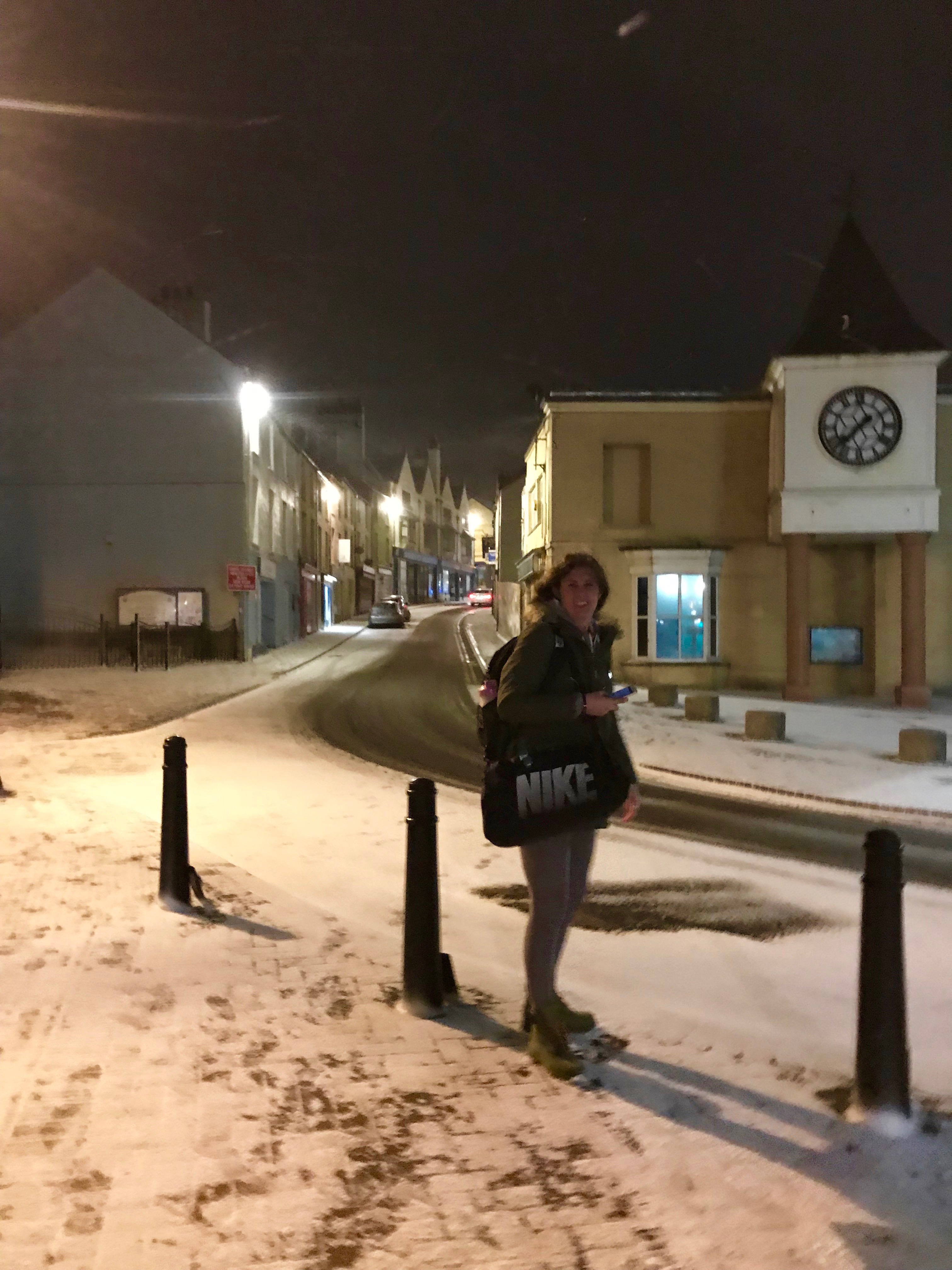
The final hiccup to our journey was having to wait aboard the ferry a total of six hours before the boat finally left the port. Exhausted and eager for home, I curled up on a couch among strangers and fell asleep without trouble. We docked in Dublin at a late 11:30am on Saturday morning.
I thought we’d be kissing the ground when we reached Ireland. I thought we would be crying out in glee or laughing deliriously or feeling something other than this heavy, lethargic acceptance. We had been through the wringer and back again, bumming our way across nations, all to make it back here. I felt as though I carried the weight of our journey in the duffel bag slung across my shoulder, and I wanted nothing to do with it anymore. Arriving back in my cozy little room, I dropped my instruments of travel and fell into bed.
I look back upon those three days with something akin to pride. Together, my friend and I learned we can do just about anything now, that a cancellation or several is less of an obstacle as it is a fork in the road; that it’s better to laugh in the face of frustration and the things we can’t control, then to grab our backpacks and move onto Plan B. Or G, or P.
Because, truthfully, the journey is delightful in the moments between things falling apart.
I learned that making a list of 100 things to accomplish in my lifetime is not only easier than it sounds, it is also supremely restorative to the disappointed heart.
Number 100 on my list: be able to look back and feel constant gratitude.
So far, so good.

 Eliana Jordan
Leave a comment